<?xml version="1.0" encoding="utf-8"?><feed xmlns="http://www.w3.org/2005/Atom" ><generator uri="https://jekyllrb.com/" version="3.10.0">Jekyll</generator><link href="https://blog.nihonium.dev/blog-feed.xml" rel="self" type="application/atom+xml" /><link href="https://blog.nihonium.dev/" rel="alternate" type="text/html" /><updated>2026-09-29T13:52:22-07:00</updated><id>https://blog.nihonium.dev/blog-feed.xml</id><title type="html">The Nihonium Files</title><subtitle>A rather odd blog</subtitle><author><name>Nihal Gulati</name></author><entry><title type="html">The Sameness of Life</title><link href="https://blog.nihonium.dev/post/the-sameness-of-life/" rel="alternate" type="text/html" title="The Sameness of Life" /><published>2022-02-06T23:08:02-08:00</published><updated>2022-02-06T23:08:02-08:00</updated><id>https://blog.nihonium.dev/post/the-sameness-of-life</id><content type="html" xml:base="https://blog.nihonium.dev/post/the-sameness-of-life/"><![CDATA[<p><img src="/assets/images/the-sameness-of-life-1.png" alt="" /></p>

<p>Human experience is a curious thing. Whenever or wherever you are, the present merely seems like the present. Your life feels remarkably like one ordinary day after the next.</p>

<p>This sameness of daily life, and correspondingly, how things look so different in the rearview mirror, are just concepts of your psychology.</p>

<p>We’re adaptive creatures, meant to thrive when placed in any environment. Because of that, our brain is <em>comparative.</em> We look at things in terms of changes from the usual because that’s what has been evolutionarily helpful. For example, you don’t regularly register the feeling of your clothes on your body until it changes or something reminds you, like this sentence.</p>

<p>Our day-to-day existence is subject to this. Our brain always considers our highs and lows in context with our normative line, or in layman’s terms, our average day. If there’s a drastic change in circumstance, like moving to a new school, then that normative line is reset over time.</p>

<p>The implications of this are that everyone feels the same highs and lows, even with drastically different lives. A member of Congress agonizing over writing an amendment to a proposed bill may feel a similar level of anxiety to you trying to finish up an English essay just before it’s due. Objectively, they’re crazy far apart in importance, but subjectively, it’s a lot closer. Emotionally, your day and a Congressperson’s day are about the same. Barring depression, which causes a brain chemistry imbalance in your normative line, <em>everyone’s</em> average day is about the same.</p>

<p>Similarly, college applications have taken up most of my brain space over the last few months; however, after their completion, I feel the same. My day-to-day life is a lot freer as a second-semester senior, and I remember how much work I had to struggle through last semester, yet the realism of it has faded. I feel not much happier or sadder now than before.</p>

<p>Replacing the workload of college applications, I have given myself academic projects: BattleCode, the Solar Regatta team, Mock Trial. They’ve risen to occupy the same unfilled space.</p>

<p>There is a lesson to take from this: live in the present and be grateful for that present. You will always have negatives in your life, and you’ll look to the past or future with envy. Things were so great when I didn’t have to deal with <em>this</em>, or life will be phenomenal once I’m past <em>this</em>. And it’s not true.</p>

<p>Eventually, you’ll be in the future, and it’ll <em>feel</em> just the same as before. And when you look back, you’ll see all the positives in that past-present that you somehow missed while in it.</p>

<p>Life is one and done. The present that you are in now, yes, at this exact moment right at the end of January 2022, is the time to enjoy yourself, rather than a supposed future time “when you’re free.” (Clearly, don’t blow off schoolwork. That’s not my meaning.)</p>

<p>Value where and when you are. Isn’t the fact that we’re living in this amazing world, at this amazing time — the fact that we exist at all — wonderful? Our ability to quickly adapt to life is helpful to carry out our daily business, but it can keep us from seeing how marvelous our present really is. Sometimes, only a perspective change is needed to see past the mundanity of daily life to the beautiful now.</p>

<p>Carpe diem<em>.</em></p>]]></content><author><name>Nihal Gulati</name></author><summary type="html"><![CDATA[Human experience is a curious thing. Whenever or wherever you are, the present merely seems like the present. Your life feels remarkably...]]></summary><media:thumbnail xmlns:media="http://search.yahoo.com/mrss/" url="https://blog.nihonium.dev/assets/images/the-sameness-of-life-1.png" /><media:content medium="image" url="https://blog.nihonium.dev/assets/images/the-sameness-of-life-1.png" xmlns:media="http://search.yahoo.com/mrss/" /></entry><entry><title type="html">Climate Change Is Bad :(</title><link href="https://blog.nihonium.dev/post/climate-change-is-bad/" rel="alternate" type="text/html" title="Climate Change Is Bad :(" /><published>2021-09-23T22:10:29-07:00</published><updated>2021-09-23T22:10:29-07:00</updated><id>https://blog.nihonium.dev/post/climate-change-is-bad</id><content type="html" xml:base="https://blog.nihonium.dev/post/climate-change-is-bad/"><![CDATA[<p><img src="/assets/images/climate-change-is-bad-1.jpg" alt="" /></p>

<p>Here’s an editorial I just wrote for the Octagon on the new IPCC report and what we can do.</p>

<p>Also, Kurtzgeztagt, right after our issue was published, also released a video on a similar topic here: <a href="https://www.youtube.com/watch?v=yiw6_JakZFc">https://www.youtube.com/watch?v=yiw6_JakZFc</a></p>

<p><strong>By NIHAL GULATI</strong></p>

<p><em>News Editor and Head of Technology</em></p>

<p>Climate change is the largest issue facing humanity. It’s easy to disregard its existence, or claim it’s not caused by humans, or fall into the trap of thinking that we can’t do anything about it. All of those are false. Although most major changes, such as carbon caps, have to be implemented by the government, there are things all of us can do.</p>

<p>Part of the issue is that climate change never feels imminent or dangerous. We consider it to be something in the far future, something that only comes up in the occasional hurricane or fire news.</p>

<p>However, the United Nations’ Intergovernmental Panel of Climate Change served a large wake-up call with a devastating report released in August.</p>

<p>The IPCC report goes into excruciating detail and science, about 1,300 pages of it, on the exact effects humanity has been having on the world and the consequences of those actions.</p>

<p>Overall, the message is hauntingly simple and sobering: Humanity is in trouble.</p>

<p>The IPCC report summary, conclusion A.1 says: “It is unequivocal that human influence has warmed the atmosphere, ocean and land. Widespread and rapid changes in the atmosphere, ocean, cryosphere and biosphere have occurred.”</p>

<p>Conclusion A.1.1: “Observed increases in well-mixed greenhouse gas (GHG) concentrations since around 1750 are unequivocally caused by human activities.”</p>

<p>Conclusions A.1.2 and A.1.3: “Each of the last four decades has been successively warmer than any decade that preceded it since 1850,” with a “best estimate” of 1.07°C increase since 1850-1900.</p>

<p>Note the definite nature of the statements, the use of the word ‘unequivocally.’ This is nothing new; it’s what has been described by previous researchers. The difference in this report is how clear it makes it.</p>

<p>The summary alone is about 41 pages. Besides the basics of rising temperatures and CO2 emissions, it covers everything from changes in the sea to historical climate change precedent to the consequences of warming, then concludes with how unusual and “unprecedented” these changes are.</p>

<p>The report also lays out possible futures, saying that “Global warming of 1.5°C and 2°C will be exceeded during the 21st century unless deep reductions in CO2 and other greenhouse gas emissions occur in the coming decades.”</p>

<p>If you are still hazy about whether you think human activity has led to global warming or if you don’t believe global warming is happening, please read the full report summary from the link here. It mostly speaks for itself.</p>

<p>Then, if you are convinced by the science, you may be feeling a bit defeatist about all of this. The report paints a picture of drastic consequences, with only slim possibilities of avoiding them.</p>

<p>However, all that means is that humanity needs to work harder. The amount we cut back our greenhouse gas emissions and increase carbon dioxide sequestration efforts will directly affect the temperature change we end up with a century from now.</p>

<p>We still have the power to turn this from a catastrophic 3°C increase to something more manageable, like under 1.5°C.</p>

<p>The report offers multiple models based on emission futures. There are some irreversible effects to our climate — sea level rise and temperature, for example — but most of the others can be fixed given the proper carbon-cutting measures.</p>

<p>The responsibility of enacting these measures falls mainly on lawmakers; they need to implement restrictions and limitations on emissions and wastefulness in our industries. Without government intervention, there’s little chance our companies and economy would rise to meet this issue over their own profit.</p>

<p>And there is precedent for government intervention fixing a climate issue. When humanity started facing the problem of acid rain, caused by sulfates that factories were dumping into the air, then the government started setting strict caps. Factories cut down, even all cars were fitted with remarkably-efficient catalytic converters which reduced their emissions. Now, we barely register acid rain as an environmental problem because, for the most part, we fixed it.</p>

<p>You could say the same for the use of CFCs in aerosols that caused problems for the ozone layer. CFCs banned, hole in the ozone layer slowly repairing itself.</p>

<p>The biggest way we can help with this is to contact our legislative representatives. Science teacher Cade Grunst especially emphasizes this.</p>

<p>You can pick up the phone or send an email once a year to your local, state and federal representatives. Tell them you want climate change regulations enacted.</p>

<p>Most likely, an automated system will have you leave a message, and the number of people that call about certain issues will be tallied.</p>

<p>It seems like a small effort, but say if thousands of people called Congress to advocate for this, Congress would absolutely do something about it.</p>

<p>But what can <em>we</em>, Country Day and we as individuals, still do?</p>

<p>According to the president of the Environmentalist Club, junior Adam Akins, it’s very easy to get caught up in the perception that nothing you do can make a difference.</p>

<p>“Any attempt at conservation has small effects, especially in the people around you, in the way that it changes the culture,” Akins said. “If there’s a culture of saving, of being responsible, of not wasting, it will help change things long-term.”</p>

<p>Part of bringing that culture comes with education. Akins recommended learning about composting, recycling,  sustainable farming, or just learning to reduce needless waste.</p>

<p>Climate change is covered in middle school by Grunst, but is not heavily focused on in the high school curriculum.</p>

<p>Adding another, more in-depth unit on sustainability and climate change to the ninth or 10th grade curriculum, be it in the history or science classes, or even adding an AP Environmental Science course, would be a way to better educate Country Day students and eventual adults on the matter.</p>

<p>Apart from education, Country Day can take steps toward lessening its carbon emissions. Because 25% of U.S. carbon emissions are from the power sector, according to the EPA, one option would be to retrofit the existing high school and middle school building roofs with solar panels.</p>

<p>This would be an investment that would not only pay for itself in the long-run, but make a difference in our own carbon footprint.</p>

<p>As individuals, we also can consider using solar panels for our own homes. Depending on the property, you can greatly lessen your electricity bills or even get paid for excess electricity production.</p>

<p>Solar isn’t always feasible, though, and those whose electricity is provided by the Sacramento Municipal Utility District have an even better option. SMUD offers a green energy program that lets you pay a flat $4 a month fee to get half of your electricity from renewable sources or $8 a month to get all of your electricity sourced renewably.</p>

<p>It’s really not a bad deal! For less than $100 a year, you can get all your electricity from clean sources. True, there’s no technical difference between your power and your neighbor’s in an aggregate electricity grid, but either way, the money is going to SMUD’s efforts to greenify its power. Very few utilities offer an opportunity like this, and this is one of the most effective ways to reduce your carbon footprint.</p>

<p>There are additional options for businesses, so Country Day should also look into joining the green energy program.</p>

<p>Another option is purchasing an electric vehicle. According to the Environmental Protection Agency transportation accounts for 29% of the U.S. carbon emissions, so this is a large area we can cut down on.</p>

<p>Electric vehicles have become much more economical and convenient in recent years. At this point, there’s little remaining advantage to traditional gas cars. Plus, you never have to repeatedly pay $100 dollars for gas again. It’s definitely something to consider if you’re making a new car purchase.</p>

<p>Even on the small scale, just reducing the amount of unnecessary things we buy will add up to a world where we’re better at moderation, better at managing our effect on the environment.</p>

<p>There’s always something, no matter how small, that we can do for our planet. The responsibility to fix this is with us.</p>]]></content><author><name>Nihal Gulati</name></author><summary type="html"><![CDATA[Here's an editorial I just wrote for the Octagon on the new IPCC report and what we can do. Also, Kurtzgeztagt, right after our issue was...]]></summary><media:thumbnail xmlns:media="http://search.yahoo.com/mrss/" url="https://blog.nihonium.dev/assets/images/climate-change-is-bad-1.jpg" /><media:content medium="image" url="https://blog.nihonium.dev/assets/images/climate-change-is-bad-1.jpg" xmlns:media="http://search.yahoo.com/mrss/" /></entry><entry><title type="html">Fragment Of A Story, Cere Junda vs. Vader</title><link href="https://blog.nihonium.dev/post/fragment-of-a-story-cere-junda-vs-vader/" rel="alternate" type="text/html" title="Fragment Of A Story, Cere Junda vs. Vader" /><published>2021-08-29T22:50:19-07:00</published><updated>2021-08-29T22:50:19-07:00</updated><id>https://blog.nihonium.dev/post/fragment-of-a-story-cere-junda-vs-vader</id><content type="html" xml:base="https://blog.nihonium.dev/post/fragment-of-a-story-cere-junda-vs-vader/"><![CDATA[<p>Ferns rustled. A gentle wind blew. A not-quite-yellow sun shone warmly over the open field where the Jedi was meditating. But the scenery the Jedi was seeing was quite different. He was seeing the Force.</p>

<p>Different individuals internalized the idea of the Force in various ways. In this one’s mind, there was wind. The Jedi saw calmer, slow breezes, quick wind eddies, far-away tempests. In his meditation, he floated along with its vast gales, letting it show him what it would. The Force often gave him visions in this wind-form, of places and people, images that could have present, the distant past, the far future. The Jedi didn’t —</p>

<p>a sharp gust rocked him, suddenly swirling and roaring and whipping and —</p>

<p>She reached out into the life-current and seized the vibrating threads. All her anger, hate, her feeling of lack of control doubled over into a single thought. She wanted to hurt him. The Force responded in kind, changing from the calm current she had always known to a roiling, powerful current tangled in her grasp, reflecting back all of her emotions and a savage joy in its own strength. <em>So THIS is the true power of the Force</em>. An unfamiliar cruel grin appeared on her face as she reached out farther into the current, impressing her will on the Force. The threads tingled and snapped with energy, <em>emotion</em> and she felt an ice-fire rush of pure strength travel through her. She released it, using her will to reshape the universe as she saw fit. <em>BOW.</em> In a more detached part of her, she reflected that this savage fire-ice power was just as much in the nature of the Force as the calm nature she had been trained to use, albeit a side of which she hadn’t begun to understand the raw emotion-power of.</p>

<p>“Such hatred…You would have made an excellent Inquisitor,” <strong>he</strong> said in his deep, mechanical, implacable voice.</p>

<p>The Jedi released the memory. Or rather, the memory released him.</p>]]></content><author><name>Nihal Gulati</name></author><summary type="html"><![CDATA[Ferns rustled. A gentle wind blew. A not-quite-yellow sun shone warmly over the open field where the Jedi was meditating. But the scenery...]]></summary></entry><entry><title type="html">Doing Reinforcement Learning for my Internship!</title><link href="https://blog.nihonium.dev/post/doing-reinforcement-learning-for-my-internship/" rel="alternate" type="text/html" title="Doing Reinforcement Learning for my Internship!" /><published>2021-08-13T04:10:26-07:00</published><updated>2021-08-13T04:10:26-07:00</updated><id>https://blog.nihonium.dev/post/doing-reinforcement-learning-for-my-internship</id><content type="html" xml:base="https://blog.nihonium.dev/post/doing-reinforcement-learning-for-my-internship/"><![CDATA[<p><img src="/assets/images/doing-reinforcement-learning-for-my-internship-1.png" alt="" /></p>

<p>So, I’ve been working on my internship, actually, the last couple of weeks.</p>

<p>It’s really engaging stuff. The last time I updated you guys on the internship, I was still collecting data every day on manufacturers. It was grueling stuff, but the coding kept me well in.</p>

<p>Then, after I finished the collection, (and had a week of no assignments), Trevor (the PhD student I’m working with at UC Davis, along with Professor Assadian) and I started the next amazing phase, the reinforcement learning.</p>

<p>So, as part of the chapter, the professor thought we ought to have an example of how AI can be used in safety features (since that’s what the chapter we’re writing is focusing on), so Trevor came up with the ‘using reinforcement learning to create automatic collision avoidance systems’.</p>

<p>In NHTSA terminology, those would be the AEB (Automatic Emergency Braking) and the AES (Automatic Evasive Steering) features in cars.</p>

<p>Anyway, that week while I was chilling, Trevor was adapting a set of OpenAI Gym environments to fit our needs. OpenAI, if you didn’t know, is a big company owned by Microsoft, they do a lot of work on researching cutting-edge AI.</p>

<p>Their ‘Gym’ project is an open-source set of code for training reinforcement algorithms.</p>

<p>And… I realized I should probably explain what reinforcement learning is.</p>

<p>So, reinforcement learning, at its base, is the idea of using neural networks to control the actions of an ‘agent’ in an environment.</p>

<p>This could anything from controlling an Atari Breakout paddle and trying to win the game to learning to walk to driving a car.</p>

<p>And that last case is exactly what we were working on.</p>

<p>But anyway, Gym is there to standardize the interface for how an agent communicates and sees in an environment. It almost makes it plug-and-play. You can pick any model that has been built to interface with Gym (there’s a lot of them) or code your own. You can pick any environment as well, or code your own.</p>

<p>So, Trevor started with a GitHub repository that already had a ton of driving environments. He forked it, and created our own collision environment within.</p>

<p>GitHub link: <a href="https://github.com/tvidano/highway-env">https://github.com/tvidano/highway-env</a></p>

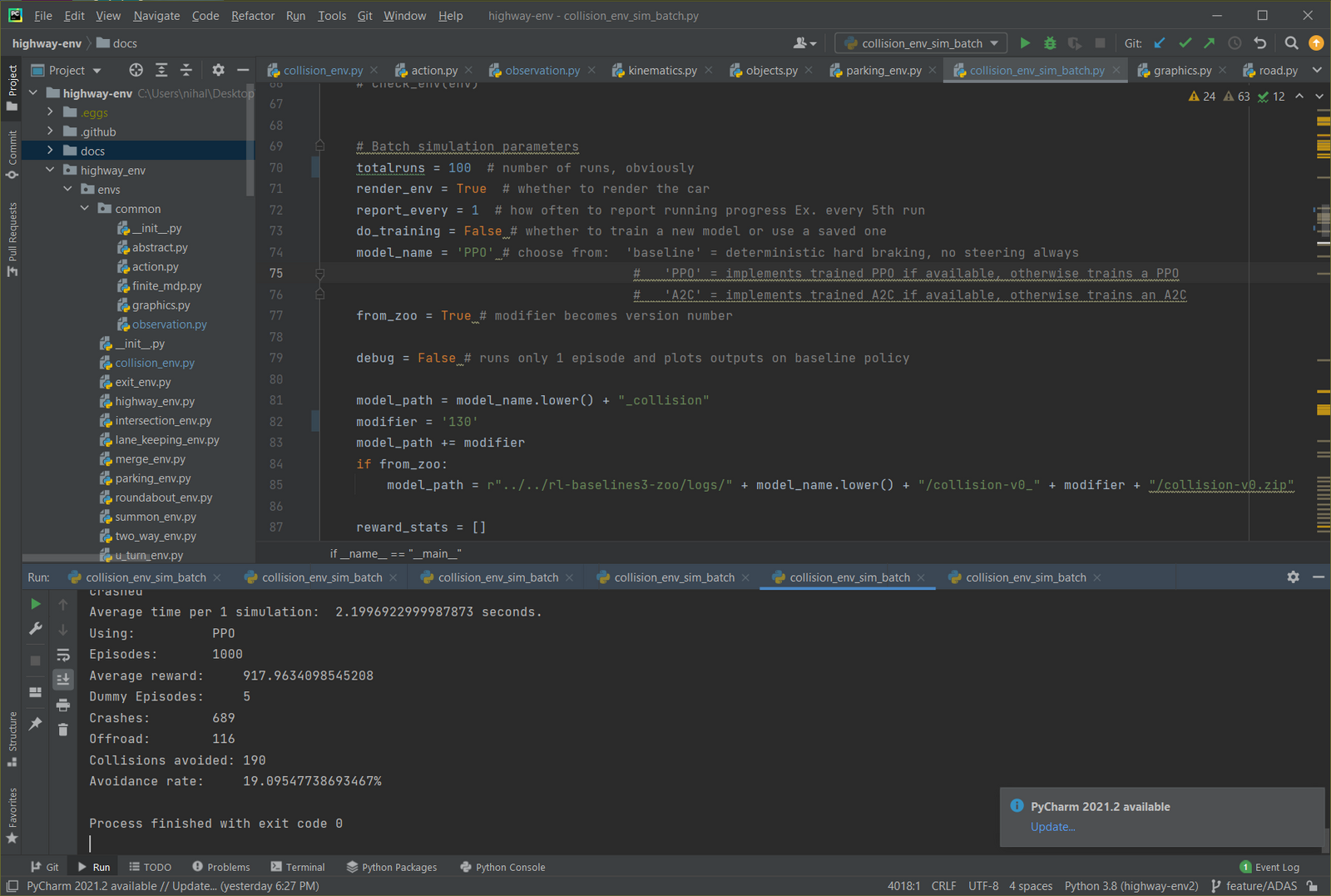
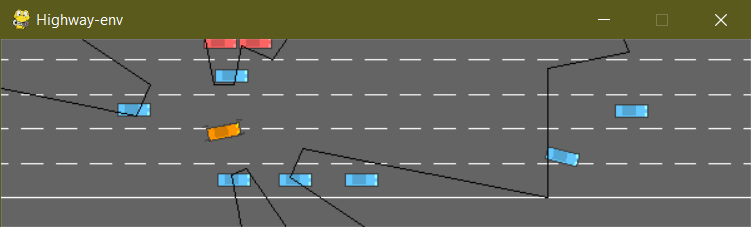
<p>It’s a simple straight highway, with a number of basic cars around and one controlled car. When the car is close to a collision, the AI model takes control and has to learn how to stay alive and not crash. You can see a pic up above.</p>

<p>Trevor spent the better part of that week making the collision env. He had to rewrite a good chunk of the original repository as well, to add tire locking and skidding and other simulation-like-things.</p>

<p>When I got sent the repository, it took me pretty much two days to figure out what the heck was going on. I don’t actually have a great bank of coding knowledge, my strength in coding comes mostly from my ability to learn and work with new code quickly.</p>

<p>Once I properly understood it, I wrote a batch script that trained a model and collected statistics on how well it had done, like survived 173 times and crashed 394 times, and also gave a percent of runs it dodged correctly.</p>

<p><img src="/assets/images/doing-reinforcement-learning-for-my-internship-2.png" alt="" /></p>

<p>And then, we had to train a model that was better at avoiding collisions than just hard braking was. Should take maybe a week, no?</p>

<p>Nope. Couldn’t do it. No matter what I or Trevor trained, it just was never good enough compared to braking was. Turns out self-driving is hard!</p>

<p>Anyway, we basically went on a spree of interactions. We would try everything, training models over and over again with different variables.</p>

<p>I was able to run multiple models at once, you know, self-built PC with pretty good specs.</p>

<p>Totally overloaded my computer occasionally, running 10-12 models at once. (Neural nets are pretty heavy computationally, so it was a lot.) Love you, computer, you’re a beast.</p>

<p>But we tried EVERYTHING. We tried changing the rewards function, so many times.</p>

<p>(A rewards function is how the AI learns what behavior to do. You give a higher number for the behavior you want, and the AI adjusts itself to better optimize and maximize the reward.)</p>

<p>So as a result, the reward function basically controls the entire learning behavior. A clear possible culprit.</p>

<p>We tried sparse rewards, giving a reward if and only if it survived the whole time. We tried dense rewards, rewarding things from how shallow the collisions to its orientations. Penalty rewards, for going offroad, so on. My own variant function, which rewarded and penalized specific other behaviors like time alive and lateral velocity. It’s a complicated business.</p>

<p><img src="/assets/images/doing-reinforcement-learning-for-my-internship-3.png" alt="" /></p>

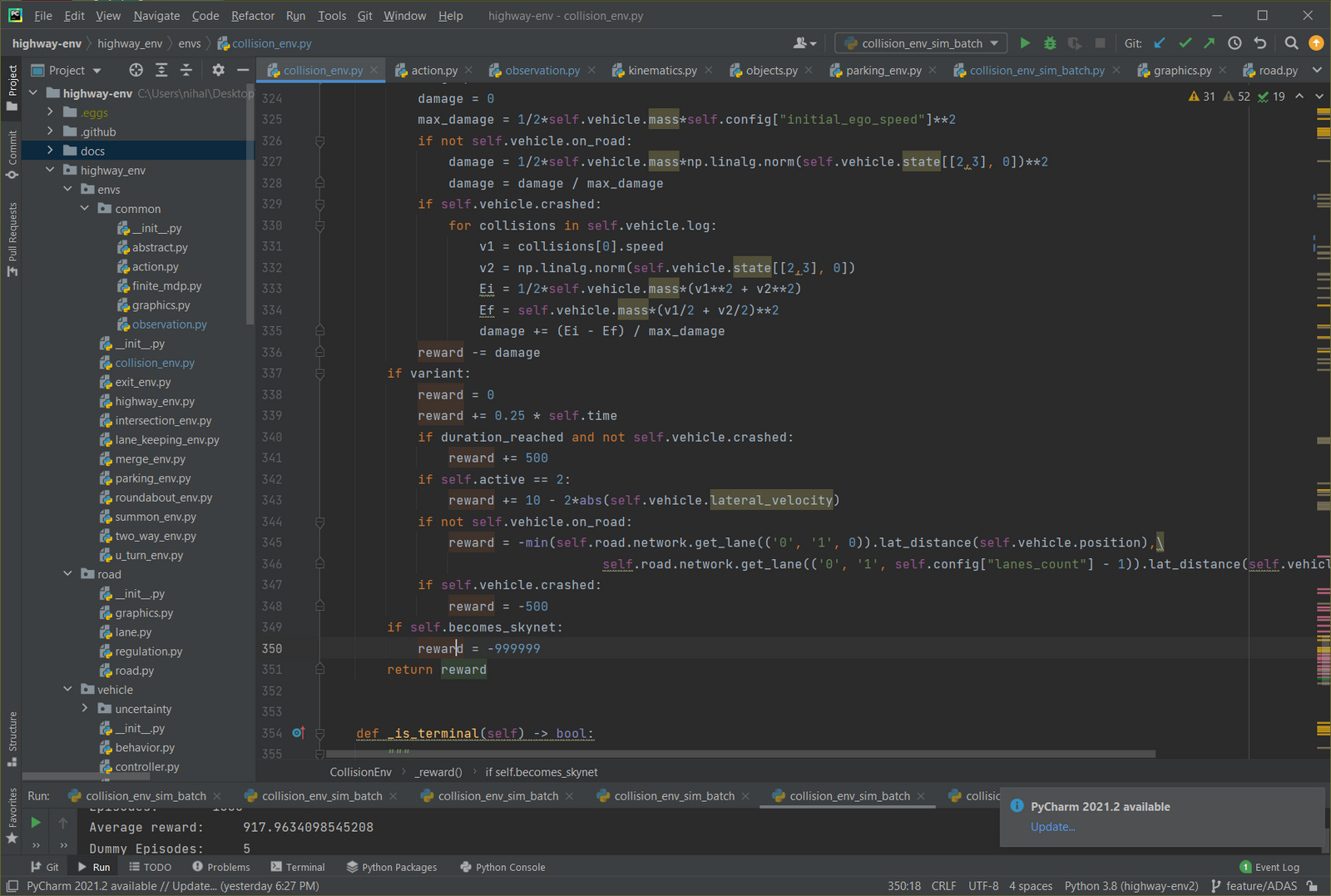
<p>A piece of the reward function. You can see, under the ‘if variant:’ my special sauce reward function. It worked just as well as penalty_dense, though, to be honest.</p>

<p>We tried changing the observations of the AI model, what it can see. We went from giving it the xy positions of cars around it to a LIDAR-like observation, to appending the vehicle’s position and velocity to that LIDAR scheme.</p>

<p>We tried changing the environment itself, altering the time_to_collision function, changing it so that the AI only received observations and steps when it was supposed to be active and not otherwise.</p>

<p>We even set up the RL-baselines-zoo library (meant to simplify the training of models) to help us train models and hyperparameter-optimize (hyperparameters are the parameters of the neural model you start with, like how big it is, how many batches it gets, etc.). There was a registry error in the environment that took me HOURS to find before I could set it all up.</p>

<p>Yep. Still nothing. At this point, Trevor and I were basically at a loss. We sort of backtracked, focusing on training an agent that could at least just brake. We accomplished that, at least, if barely. Wow, an AI can copy hard braking.</p>

<p>We didn’t really have a choice though, since none of our other iterations could even match it. And we were pretty darn close to the deadline, maybe a week or two and there was still the writing of the chapter to be done. Trevor had been working on that alongside, luckily.</p>

<p>Fast-forward to the literal last day to submit the chapter to that UMich professor. I had been away for the last week, in New York (for reasons I may explain later). I had still been running iterations of the model, but there were a couple of last-ditch changes that had occurred to me that would have been hard to code there. Mainly, I increased the number of lanes to five and made them wider.</p>

<p>My reasoning was this: we’d altered so much of the program. The rewards, observations, environment functionality, training. There wasn’t much left that could be causing this failure. Maybe something about the situation was fundamentally giving the AI unreasonable difficulty. Essentially, the task wasn’t reasonable to do effectively, at least the way we’d phrased it.</p>

<p>It wasn’t a new thought, but I’d never been able to figure out what to do about it. Cutting the number of cars in the simulation hadn’t worked before, since the hard braking only got correspondingly better.</p>

<p>But, I figured increasing the number of lanes and width of lanes would maybe do it. Give the AI more room to work with, let it dodge amongst the cars. Good enough last-ditch effort yeah?</p>

<p>The way I’ve been leading up to it you probably already know what the outcome of those iterations were.</p>

<p>Successful indeed. An actual AI better at dodging and avoiding collisions than a simple emergency braker. Granted, some realism had been sacrificed by widening the lane, but it wasn’t excessive and it didn’t really matter since it still had worked when nothing else had.</p>

<p>Not all happy endings, though. Too late to put in the chapter. No time to draft a new section on this when we hadn’t done any further checking or analysis on the results, or when we had already written a section on a 1D hard-braker agent.</p>

<p>But, Trevor says he wants to do a whole new paper on the results of this. An AI that can both dodge and brake is an accomplishment. Ahhhh, it’s just so cool.</p>

<p>I get to work on the most complicated code I’ve ever seen, work on ACTUAL AI RESEARCH, actually eventually understand the code, SOLVE THE AI TASK that has literally taken a month, get MY NAME, NIHAL GULATI, as the third AUTHOR in this chapter for a peer-reviewed book, then maybe also CO-AUTHOR another research paper with Trevor?</p>

<p>Too cool. But how in the world can I manage all this work on top of my college application work on top of all my other work? It’s a good question. One I haven’t quite answered myself yet. Check back by November to see if I’ve overloaded and fried my circuitry yet.</p>]]></content><author><name>Nihal Gulati</name></author><summary type="html"><![CDATA[So, I've been working on my internship, actually, the last couple of weeks. It's really engaging stuff. The last time I updated you guys...]]></summary><media:thumbnail xmlns:media="http://search.yahoo.com/mrss/" url="https://blog.nihonium.dev/assets/images/doing-reinforcement-learning-for-my-internship-1.png" /><media:content medium="image" url="https://blog.nihonium.dev/assets/images/doing-reinforcement-learning-for-my-internship-1.png" xmlns:media="http://search.yahoo.com/mrss/" /></entry><entry><title type="html">A Brief Utterance</title><link href="https://blog.nihonium.dev/post/a-brief-utterance/" rel="alternate" type="text/html" title="A Brief Utterance" /><published>2021-08-09T22:36:37-07:00</published><updated>2021-08-09T22:36:37-07:00</updated><id>https://blog.nihonium.dev/post/a-brief-utterance</id><content type="html" xml:base="https://blog.nihonium.dev/post/a-brief-utterance/"><![CDATA[<p>Writing essays is hard.</p>]]></content><author><name>Nihal Gulati</name></author><summary type="html"><![CDATA[Writing essays is hard.]]></summary></entry><entry><title type="html">The Not Diverted Post, College Stuff</title><link href="https://blog.nihonium.dev/post/college-stuff/" rel="alternate" type="text/html" title="The Not Diverted Post, College Stuff" /><published>2021-07-15T13:36:57-07:00</published><updated>2021-07-15T13:36:57-07:00</updated><id>https://blog.nihonium.dev/post/college-stuff</id><content type="html" xml:base="https://blog.nihonium.dev/post/college-stuff/"><![CDATA[<p><img src="/assets/images/college-stuff-1.jpg" alt="" /></p>

<p>Ok, now I get to actually talk about the college stuff I wanted to say last time.</p>

<p>So, I’m a rising senior. Which is completely wild, by the way. A very enjoyable chapter (high school) in my life is about to close, and afterwards, there’s basically no way to go back.</p>

<p>Sure, I’ll talk to my friends, talk to my teachers, but it’ll never quite be like how I went to school back then, huh?</p>

<p>Time is really annoying like that. Especially since high school has been so fun. Wish things didn’t have to change.</p>

<p>Anyway, before I get drawn into another hole of contemplation, I should talk about college. Yes, I do in fact have to write my college apps in the next couple of months, a large portion of which will be due on November 1st. Alarmingly close, if you ask me.</p>

<p>And, well, it’s quite nerve-wracking.</p>

<p>I’m a pretty good student, I would say, and I happen to be good at test-taking.  You know, I’m that standard Indian kid with the all As and the high ACT score. So my academics are great.</p>

<p>I think I’m a strong enough candidate for even like the top-top level colleges, like MIT, Stanford, Caltech. I would definitely be considered in the applicant pool.</p>

<p>The problem is, that at this level, I’m just being compared against literally every other straight-A high-achiever. Unless I’ve cured cancer or have absolutely insane extracurriculars, it’s kind of a crapshoot. That’s the phrase everyone keeps using around me, ‘crapshoot’, and it’s irritating.</p>

<p>At some level, I don’t care too much about which college I go to. I don’t think it matters as much as it’s emphasized. But, I do feel obligated to try since I could, possibly, get into these great schools.</p>

<p>Right now, my preliminary list of where I’m applying probably looks something like this:</p>

<p>MIT, Stanford, Caltech, UC Berkeley, UCLA, UC San Diego, UC Davis, UC Santa Barbara, Harvey Mudd, University of Illinois Urbana-Champaign, Georgia Tech, U Michigan, UT Austin, Northwestern, U Penn, Carnegie Mellon.</p>

<p>Yeah, I know I’m applying to a lot of high-up places, and yeah I know my chances are shit. Reason I’m applying is because the chance is low, but not non-zero.</p>

<p>I am a lot more hopeful about some of the more medium-level colleges I’m applying to, U Mich, Georgia Tech, UIUC, those kind of places. I like them all fairly well, I’d be happy enough going there, and I don’t see myself getting rejected from all of them.</p>

<p>Still a lot of stress. I’ve started the personal statement for the common app, by the way, and boy is it hard to add finesse to it. I’m like trying to make it so great, and it’s hard. Maybe I’ll put my draft here, or something.</p>

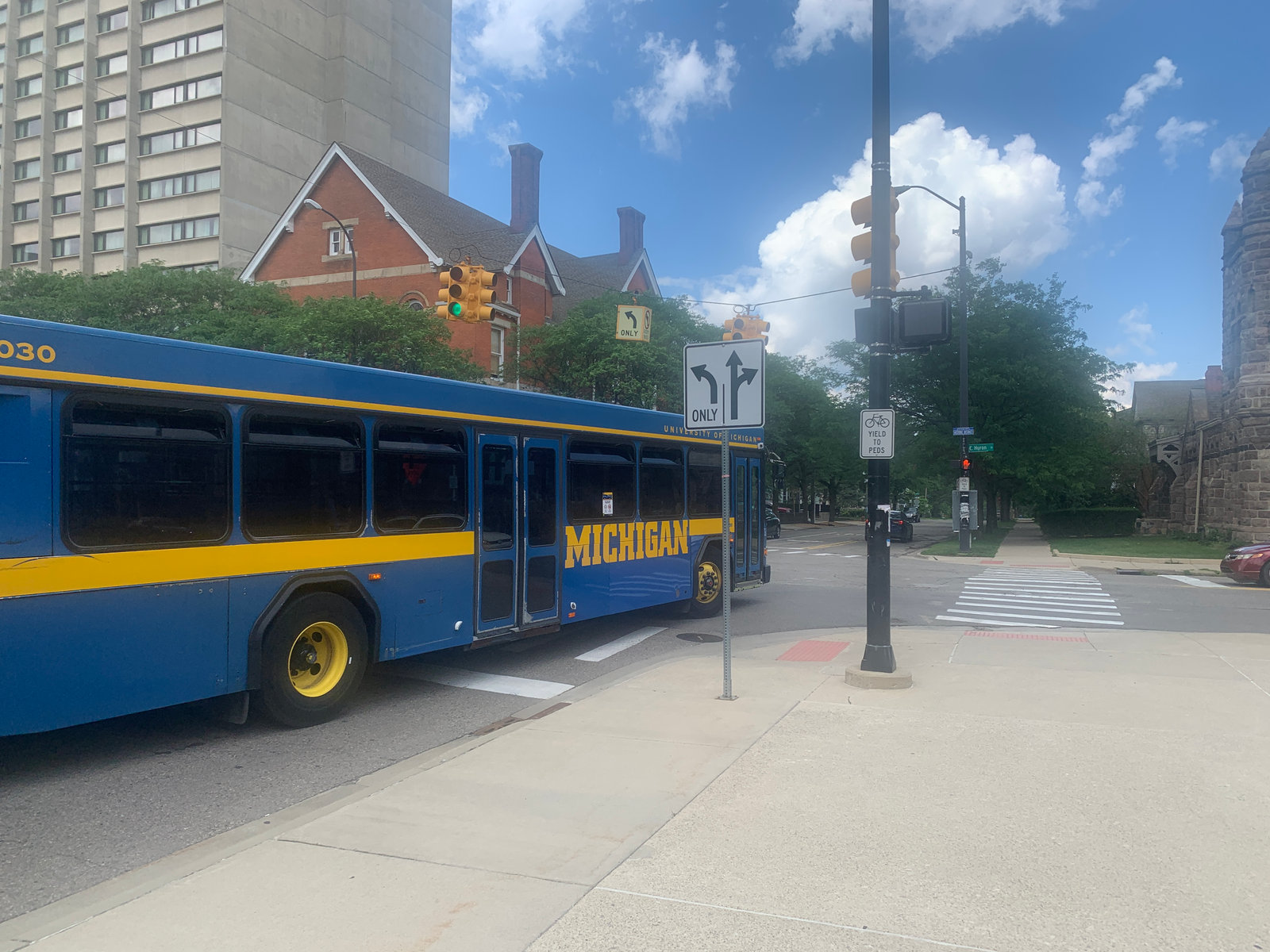
<p>Oh yeah, and the picture above is from a trip I just took to Michigan and Chicago. Cool places, for sure. I like Ann Arbor a lot, actually. Quintessential college town, tons of students around, large campus. Plus, this Punjabi dude randomly gave us a tour around the new Ford Robotics Center. Now THAT was cool. And I talked to this admissions guy who was there, Mike Oekle. Pretty decent convo, I would say. Answered a fair deal of my questions, and I hope I didn’t leave a bad impression.</p>

<p>U Chicago was also good. Total Hogwarts vibe, old buildings with ivy, tunnels. I don’t know if I like living near the city itself though. I’m not a city person. Northwestern had pretty spanky buildings too. UIUC had a bit of an older vibe, but still a cool enough town. I had a pretty good convo with a Professor/Uncle there, had lunch with them. The problem was is that there weren’t many students, if any, on the campuses here so I didn’t much get a sense of the vibe at the school.</p>

<p>All good enough places, though. I think I’ll be happy enough, in the end.</p>]]></content><author><name>Nihal Gulati</name></author><summary type="html"><![CDATA[Ok, now I get to actually talk about the college stuff I wanted to say last time. So, I'm a rising senior. Which is completely wild, by...]]></summary><media:thumbnail xmlns:media="http://search.yahoo.com/mrss/" url="https://blog.nihonium.dev/assets/images/college-stuff-1.jpg" /><media:content medium="image" url="https://blog.nihonium.dev/assets/images/college-stuff-1.jpg" xmlns:media="http://search.yahoo.com/mrss/" /></entry><entry><title type="html">Coding A Webscraper!</title><link href="https://blog.nihonium.dev/post/coding-a-webscraper/" rel="alternate" type="text/html" title="Coding A Webscraper!" /><published>2021-06-24T00:08:35-07:00</published><updated>2021-06-24T00:08:35-07:00</updated><id>https://blog.nihonium.dev/post/coding-a-webscraper</id><content type="html" xml:base="https://blog.nihonium.dev/post/coding-a-webscraper/"><![CDATA[<p>Hey there readers! (Yes, all of my many, many, many readers, most of which are probably my two parents)</p>

<p>Yeah, yeah, I know. Two weeks have elapsed again since I last posted. So much for my schedule.</p>

<p>To be fair, I’m pretty busy. I have an internship!</p>

<p>So, I’ve been working with this Ph.D. student called Trevor at UC Davis. He’s studying to be a control engineer (sounds boring, I know, but he deals with a lot of cool AI stuff). He’s been assigned by his professor to write a chapter for a book by some Michigan professor on advanced safety features in today’s vehicles. (His lab focuses a lot on cars in particular). Essentially, our chapter’s gonna analyze what features are already in cars and how to use AI to improve the technology.</p>

<p>My job is essentially just to help him out in writing the chapter. It’s pretty fun so far. He’s had me gathering data from car manufacturer websites (specifically, which cars had which standard safety features) to include as a source in the chapter.</p>

<p>He at first was going to to it by hand (boy would that have been abject misery), but he had asked me if I could program something to take in those marketing manufacturer terms (Ex. Ford CoPilot360) and give out the NHTSA definitions (Ex. Adaptive Cruise Control (ACC) and Lane Keep Assist (LKA)), to speed up our entry.</p>

<p>Well, I did that. And then as I was trying the program out, I thought to myself, wouldn’t it be easier if I could just input the website and have it just do a simple text search from the terms? So I tried that.</p>

<p>One long night of coding later, and a lot of web searching, I had built me a web scraper. I didn’t even know what a web scaper was before this.  Google and Stack Overflow are a gift to humankind and should forever be revered. And Python deserves a callout as well, for making it so easy to just import a library and get a website’s text with a couple of lines of code.</p>

<p>And, so, I’ve just been applying the code to different websites to fill out our data. I just give it the URL of the website and a table of what features are what, and it spits out our spreadsheet.</p>

<p>It’s still a butt-ton of work, simply because of the amount of cars I’m dealing with, I think I’ve passed 600. But oh my god would this have been torture without my program. It has its uses in being able to alter my data easily as well. I can easily change a definition and rerun all the code to get my new data once it’s been set up for a manufacturer.</p>

<p>Lots of work, though, lot of work. It’s like a full-time job in terms of hours I put in, and practically worse since it’s self-paced and I’m prone to distraction and procrastination.</p>

<p>I’m definitely proud of my achievement. This is no simple piece of code, and it gets more complicated every day as I have to deal with non-standardized websites and different manufacturers doing different stuff.</p>

<p>Wait, I might as well just include it. Sorry, it’s really messy and barely commented. Not exactly fit for public viewing. But here:</p>

<p>It’s a Jupyter Notebook Python file, which you can either open if you have Anaconda installed or with Google Collaboratory (like Google Docs for Python notebooks)</p>

<p class="file-download"><a href="/assets/files/rowgenerator.ipynb" download="">&#128196; rowgenerator.ipynb</a> <span>(346 KB)</span></p>

<p>Or, you can check out my GitHub repo at https://github.com/Sihal3/ADASVehicleScraper3000.</p>

<p>Trevor, that PhD student, was really happy with it as well. He said that he had been thinking about collecting the data autonomously in some way as well but had sought to give my high-school self less of an impossible task. Boy, was he pleasantly surprised.</p>

<p>As for me, well, I just finished off Jeep and Nissan today. Gotta get started on Ram.</p>

<p>See ya!</p>]]></content><author><name>Nihal Gulati</name></author><summary type="html"><![CDATA[Hey there readers! (Yes, all of my many, many, many readers, most of which are probably my two parents) Yeah, yeah, I know. Two weeks...]]></summary></entry><entry><title type="html">Senior Superlative - My Page Design</title><link href="https://blog.nihonium.dev/post/senior-superlative-my-page-design/" rel="alternate" type="text/html" title="Senior Superlative - My Page Design" /><published>2021-06-06T15:01:42-07:00</published><updated>2021-06-06T15:01:42-07:00</updated><id>https://blog.nihonium.dev/post/senior-superlative-my-page-design</id><content type="html" xml:base="https://blog.nihonium.dev/post/senior-superlative-my-page-design/"><![CDATA[<p>I’ve mentioned before that I’m a page editor for the Octagon, my school newspaper., meaning I essentially make one of the pages for our monthly issues. Anyway, for our last issue of the year a couple weeks ago, I asked for backpage.</p>

<p>For some reason, SANJANA (love you Sanjana) always saw fit to assign me to the Editorial or News pages at the beginning of the year, and I’ve never had that many design-y pages. And backpage is very design-y.</p>

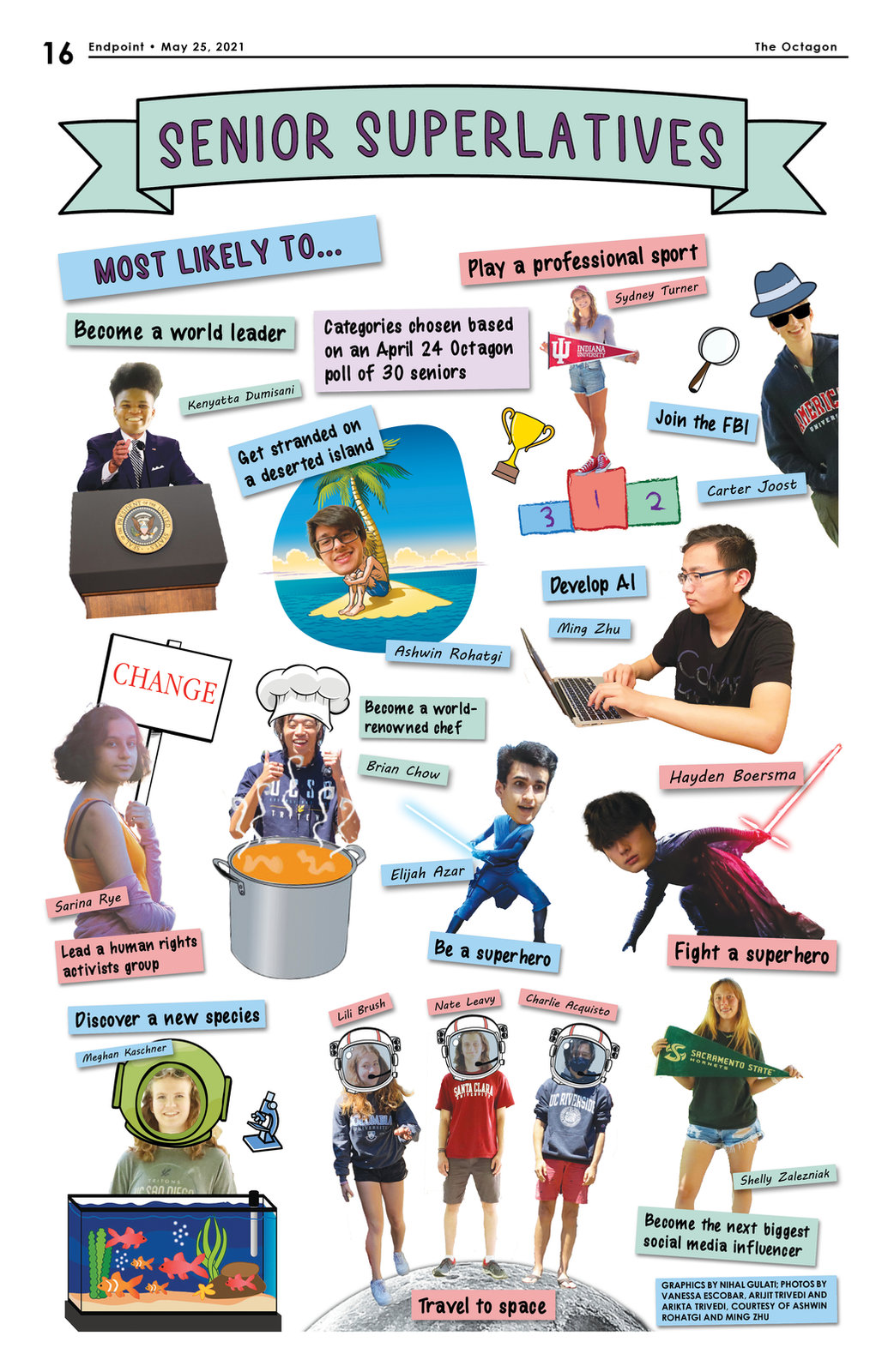
<p>This issue’s was maybe too much so. Here it is:</p>

<p><img src="/assets/images/senior-superlative-my-page-design-1.jpg" alt="" /></p>

<p>OK, BOY WAS THIS A LOT OF WORK.</p>

<p>First off, this was smack-dab in the middle of May, so I had all my AP exams going on. And, oh so many assets and cut-outs. This took me practically a dozen hours.</p>

<p>Senior superlatives are essentially just those yearbook titles that people get assigned, as you can see. So, Kali polled all of the seniors on these, and this is essentially what we got.</p>

<p>I had to figure out how to stuff about twenty seniors on a page with their voted roles, and have it look pretty and nice. Another, lesser, page designer might have only picked a couple, made them nice and orderly and pretty, and called it a day.</p>

<p>NOT ME. I, pretty early, had a vision of just stuffing everything together, very scrapbook-esque and very Photoshop-y. It wouldn’t be nice and ordered, but hopefully, it would have a sense of purposeful messiness yet adequate design. Went through a couple of rough patches in the middle trying to fit everything, but, I think I got there. And I’m proud of it.</p>

<p>It just took a heck of a long time, really. A lot of late paste-up days that week. Later than even Sanjana stayed up on some days. I mean, I have almost 50 images on this page. Ugh, it took forever to clean those up in Photoshop. Longer even to just come up with what I wanted to do for each person first. Then ages at the end trying to stuff it all together without any gaps or odd spacings.</p>

<p>Boy, did those seniors have a laugh.</p>

<p>If you’d like to check out the Octagon website, here it is: <a href="https://scdsoctagon.com">scdsoctagon.com</a>. You can even get email notifications for new stories! (I know the website is a bit slow, I’m working on that, ok?)</p>

<p>My personal staff page with my stories is here: <a href="https://www.scdsoctagon.com/author/ngulati22scdsstudent-org/">author/ngulati22scdsstudent-org</a></p>

<p>Thanks for reading!</p>]]></content><author><name>Nihal Gulati</name></author><summary type="html"><![CDATA[I've mentioned before that I'm a page editor for the Octagon, my school newspaper., meaning I essentially make one of the pages for our...]]></summary><media:thumbnail xmlns:media="http://search.yahoo.com/mrss/" url="https://blog.nihonium.dev/assets/images/senior-superlative-my-page-design-1.jpg" /><media:content medium="image" url="https://blog.nihonium.dev/assets/images/senior-superlative-my-page-design-1.jpg" xmlns:media="http://search.yahoo.com/mrss/" /></entry><entry><title type="html">AP Psychology…..</title><link href="https://blog.nihonium.dev/post/ap-psychology/" rel="alternate" type="text/html" title="AP Psychology….." /><published>2021-06-06T14:42:36-07:00</published><updated>2021-06-06T14:42:36-07:00</updated><id>https://blog.nihonium.dev/post/ap-psychology</id><content type="html" xml:base="https://blog.nihonium.dev/post/ap-psychology/"><![CDATA[<p><img src="/assets/images/ap-psychology-1.png" alt="" /></p>

<p>Yeah, remember when I just said I was done with all of my AP exams? Well, I wasn’t exactly. I still had my good old AP Psych exam just last Thursday. That, along with an internship I just got for this summer, is essentially what I’ve been doing since my junior year ended. (Yeah, my school’s over! So anticlimactic. No goodbyes, yearbooks, or anything. We just kind of finished.)</p>

<p>Anyway, the reason I didn’t mention Psych as one of my exams is because it’s not actually a class that I’m taking. Me and my friend, Arijit, decided back in the winter that we wanted to self-study AP Psych and take the exam, just for funsies and because psych is seriously interesting.</p>

<p>Obviously, this was Arijit’s crazy idea. He’s the type to come up with the strangest plans on a whim and then just try and execute them. The goal was to, over the semester, learn the units from the Barron’s book that reviewed for the exam, then just take the test and see how well we could do.</p>

<p>…</p>

<p>Yeah, that didn’t happen. Both of us were busy enough that by the time AP exams rolled around, we’d both done maybe one or two units, combined. This put us in quite a bind to be able to prepare for the Psych exam, originally on May 20, along with all of our other APs. But, we tried.</p>

<p>As soon as my AP Chem exam finished on May 7, I had essentially two weeks to prepare. I tried to do one unit a day, leaving a couple days at the end to review. I wasn’t taking notes or reviewing vocab, just reading the chapter basically (Hint: the vocab is actually really important for Psych, as I would learn) so that meant I could move at a reasonable pace and stay on track. Arijit went a bit in the opposite direction, taking notes and making flashcards for the chapters. He definitely wasn’t on track, but he really got the chapters he read down.</p>

<p>Bit of a deus ex machina, but we were able to get the exam moved to the backup Administration 3 date of Thursday, June 3, after all of our other APs.</p>

<p>The weekend before, however, I was more focused on my summer internship. What I am essentially doing in that internship is data collection, at the moment. I’m working with a PhD student (control engineer) to help him write a chapter for a peer-reviewed book on machine learning and vehicle safety features. One of the parts in our chapter is what cars have what driver assist systems, exactly. So that’s what I’m doing. It’s a lot of work, even now, and I’m kind of behind. So much for summer.</p>

<p>Back to Psych. Arijit and I really got cracking the Tuesday and Wednesday before the exam. He somehow blazed through the entire second half of the book during those days, keeping up his vocab prep. I had already finished all the chapters, and discovered that I needed a fair bit of vocab help even though I had most of the concepts down. So I reviewed that.</p>

<p>And we both did a couple of AP prep tests together. The Psych exam has about 100 multiple choice in 70 minutes, (way more than any other exam). Either you know them, or you don’t. Knowledge of vocabulary really helps here. Some of them were statistics questions (psych has a lot of statistics, apparently), and since I’ve taken AP Statistics those were easy claps.</p>

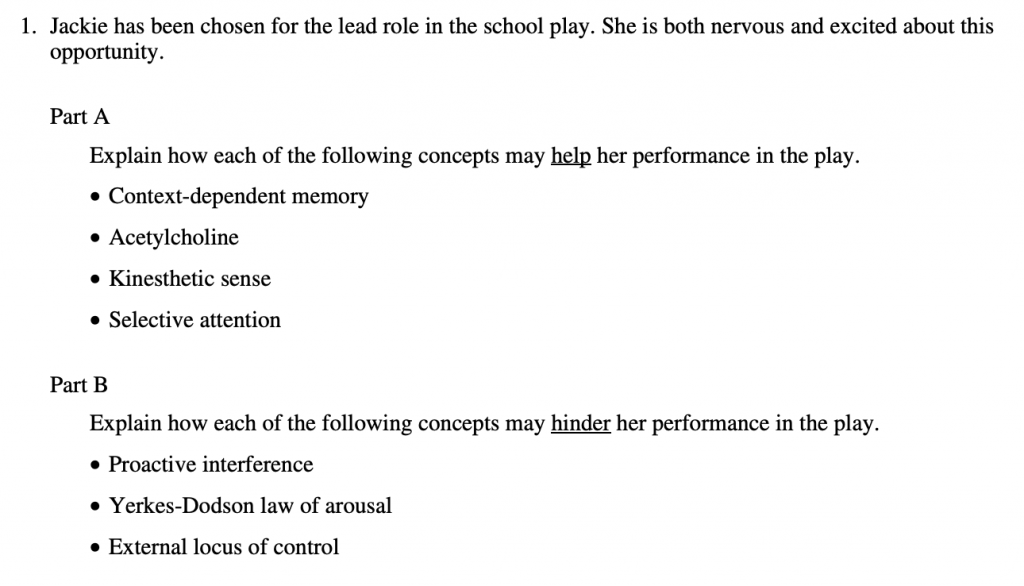
<p>The exam also has two FRQs. The first one gives you a situation and about seven psych terms that you have to define and relate to a topic. The picture at the top is an example. Obviously, again, very vocab-based. The second FRQ also has maybe three or four terms like the first but also has maybe three or four experimental questions. Stuff like, what is the operational definition of the dependent variable or what does this experimental design block for, etc.</p>

<p>Anyway, we both walked in (Well, not walked in. Sat down, since we were taking it at home.) at 1 P.M. to the psych exam, having studied together a lot of last night and a couple of hours before the test.</p>

<p>And we did ok! Gauging our performance from our practice tests, we got probably 80/100 on the MCQs and 5-6/7 on the FRQs. Checking <a href="https://albert.io">Albert.io</a> for our predicted AP score, we could easily have gotten either a high four or low five. (AP tests are graded 1-5). Which is really not bad for self-studying an entire class.</p>

<p>I’m proud of us, honestly. Psych was interesting, studying together was fun, even the AP test itself was pretty good. And if we got FIVES, that would be freaking amazing. We’ll have to wait till July to see.</p>]]></content><author><name>Nihal Gulati</name></author><summary type="html"><![CDATA[Yeah, remember when I just said I was done with all of my AP exams? Well, I wasn't exactly. I still had my good old AP Psych exam just...]]></summary><media:thumbnail xmlns:media="http://search.yahoo.com/mrss/" url="https://blog.nihonium.dev/assets/images/ap-psychology-1.png" /><media:content medium="image" url="https://blog.nihonium.dev/assets/images/ap-psychology-1.png" xmlns:media="http://search.yahoo.com/mrss/" /></entry><entry><title type="html">Happiness as a Goal</title><link href="https://blog.nihonium.dev/post/happiness-as-a-goal/" rel="alternate" type="text/html" title="Happiness as a Goal" /><published>2021-05-26T16:07:27-07:00</published><updated>2021-05-26T16:07:27-07:00</updated><id>https://blog.nihonium.dev/post/happiness-as-a-goal</id><content type="html" xml:base="https://blog.nihonium.dev/post/happiness-as-a-goal/"><![CDATA[<p>First off, I want to apologize for not posting the last couple of weeks. I’ve been incredibly busy with AP exams. If any of you are high schoolers, you’ll know what I’m talking about. I’ve had effing 7 APs in the last couple weeks plus an Octagon paste-up, so I haven’t had time to post anything. My last AP was this morning, AP English Language &amp; Composition, so now I should be back to posting around every Wednesday. Anyway, for today, I just wanted to post a quick unedited essay that I wrote under a timed 30 minute AP prompt.</p>

<p>Here it is:</p>

<hr />

<p>Happiness is the ultimate goal of life. Most people would agree that a truly happy person has lived the best life possible. However, Professor Barry Schwartz in this passage is also right. The relentless pursuit of happiness can drag down that goal and ruin what you already have. People should strive to be their happiest selves, but most of happiness is being content with what you already have, not an item to seek.</p>

<p>Part of the problem is that when people try and chase happiness, they often go after the short-lived version of happiness. The kind you get when playing a video game or buying a cool item. A chaser of happiness could turn into an adrenaline junkie, or into a hoarder of expensive items that they don’t really need, hurting themselves to get to their next high. I can testify that this kind of happiness is important. I mean, who doesn’t like to play video games every once in a while? But you can’t be that kind of happy all the time, and I can testify to that as well. Playing video games all day? It becomes empty real fast if you don’t do other things with your life. Really, the whole goal of CONSTANT happiness is illogical. No one can have that, nor is it satisfying to experience endless joy with no reference frame of sadness.</p>

<p>So, when we say the true pursuit of happiness, we aren’t referring to that temporary state of elation. Physiologically, it’s unsustainable. Your brain is not built to be overjoyed all the time. You can see this kind of effect exemplified in drug highs. When you take dopamine-inducing drugs, that high becomes your happy, and everything else pales in comparison. Your brain adjusts to its elevated dopamine level, and what was once happy is now routine, and you now are forced to go to greater heights in your search of elation. That kind of happiness is just not meant to last, nor should it. You need to experience low points as well as high to truly appreciate both.</p>

<p>What, then, are we actually pursuing, if not what we generally consider as happiness? What we really mean when we say a person is truly happy is that they are content, satisfied. It’s a deeper form of happiness, one that persists through good days and bad, and this is what people should refer to when they say the pursuit of happiness. A better name for it might be peace.</p>

<p>Then the pursuit of happiness can be a positive thing, if done right. It does not mean the chase of temporary elation, nor feeling good all the time. And you don’t pursue it by buying items or skydiving. You pursue it through self-reflection and an acceptance of your life. Really, chasing peace isn’t a chase at all. Everything you need for peace is always inside you. Humanity would do well to remember that.</p>

<hr />

<p>Ok, dramatic closing sentence, I know, but I was timed and I couldn’t think of anything better. Anyway, I was pretty proud of this essay, even though it would probably only receive a 4/6 on the actual exam, due to me not integrating evidence properly as the rubric requires. BUT, I think it’s sick anyway, which is why I posted it. And, you know, I had English on the brain today. I’ve written flipping three essays today, you know? One bad and two ok, but it’s whatever. See you next week. :)</p>]]></content><author><name>Nihal Gulati</name></author><summary type="html"><![CDATA[First off, I want to apologize for not posting the last couple of weeks. I've been incredibly busy with AP exams. If any of you are high...]]></summary></entry></feed>